

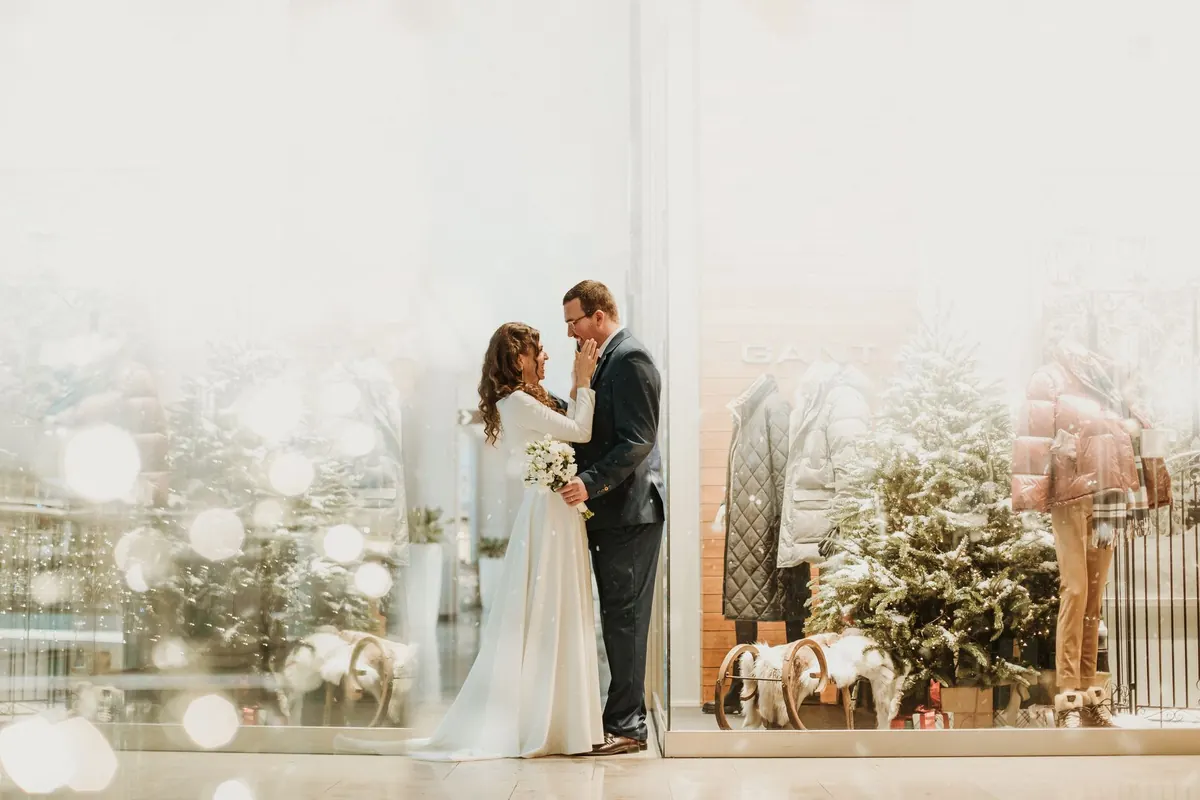

Winter weddings are too often treated as the awkward season — the one you shoot for love rather than for the portfolio. That is a mistake worth correcting. A frost-covered churchyard at eight in the morning, a reception lit by candles and forty guests, a bride crossing a cobbled square under a borrowed umbrella: these are the photographs couples remember, and the ones that persuade next winter's enquiries that you are the right person for the job.
The work is rarely in the shooting. It is in the curation. Most photographers have strong winter material sitting in a folder labelled with the year, or scattered across a social feed. Pulling it into a deliberate seasonal gallery is what turns a set of good pictures into a page that books work.
Start with what the season actually gives you
Winter is not summer with worse weather, and a gallery that pretends otherwise looks thin. The season has its own visual language: contrast, warmth, small gestures, and a quality of light you cannot get in July. Read through your archive looking for these before you look for anything else.
- Cold colour outside, warm colour inside — a blue-hour exterior and a tungsten-lit room in the same frame.
- Gestures of comfort: hands around mugs, a shawl adjusted, two people sharing one coat.
- Weather as texture: rain on glass, breath in cold air, wet stone reflecting a phone torch.
- Interiors that would look ordinary in June: a dark panelled room, one good window, guests arranged on a sofa.
If you find two or three of those, you have the beginnings of a page. If you find none, the season is giving you something else — tradition, family, late-night dancing — and that is worth showing too.
Edit for a story, not a winter theme
The temptation is to fill the page with frost and fairy lights, and it never quite works. A seasonal gallery should show how you handle an entire winter day, from the getting-ready room to the last dance in a dark marquee. Twenty to thirty images is usually enough to do that honestly.
Frames that earn their place
- A wide establishing shot that makes the venue, the weather and the time of day clear in one go.
- One ceremony image in genuinely low light, proving you can hold focus and colour when it is dim.
- A portrait where the weather is doing something and the couple look pleased about it.
- Reception candids after dark: a speech, a laugh, a table lit by a single lamp.
- A closing frame — an exit, a last look back, or a quiet moment once most guests have gone.
What to leave out
Skip anything that is technically clever but emotionally flat. Skip ten versions of the same confetti throw. Skip images where the colour is a mess you never quite rescued; a tight gallery reads as confident, a padded one does not. Captions can stay short and factual — venue, town, month — because they help people recognise their own plans in yours.
Handling low light without the noise
Winter in the UK gives you roughly four usable hours outdoors and a lot of rooms that were never designed for photography. The approach that works is unglamorous: fast primes, apertures wide enough to matter, and a shutter speed high enough to stop a laugh rather than smear it. Accept a higher ISO when you must, but expose for the highlights — a bright dress is harder to recover than a dark corner.
Mixed light is the real challenge. Tungsten lamps, a window and a phone torch in one frame will not agree unless you decide which one wins, then set your white balance accordingly. Autofocus needs help too: single-point, aimed at the eye, or manual focus on a dance floor where the light keeps dropping.
Flash is not a failure. Bounced off a ceiling or a pale wall, gelled to sit close to the room's colour and combined with a slow shutter to keep some ambient glow, it will look far better than the grainy alternative. What it must never do is flatten the atmosphere you were hired for.
UK venues, rain and the plans that save you
British winter weddings tend to happen in churches, barns, listed houses and marquees, and each comes with its own rules. Ask about flash before the ceremony rather than during it, and check with the venue about confetti, sparklers and access to rooms normally closed to guests. A five-minute conversation in advance prevents an awkward one later.
Scout a wet-weather route. A cloister, a porch, a staircase with a tall window, a doorway that frames the couple against the rain — these give you somewhere to work when the plan collapses. Take two umbrellas and a cloth for your lens, keep a spare battery warm in a pocket, and let couples step outside for a few minutes rather than marching them through an hour of drizzle. Nobody photographs well while they are cold.
Building the gallery page
Give the work its own page and its own place in your navigation. Call it something plain: Winter weddings. Load a limited number of images at a decent size, keep file sizes sensible so the page opens quickly, and write two or three sentences about how you work in the dark months — that you carry lighting, that rain does not frighten you, that you know how to keep a couple warm and moving.
Then make it findable. Use a descriptive page title and alt text, mention the counties and venues where you actually work, and link the gallery from your pricing page and your enquiry form. A winter gallery nobody can find is just an archive.
Turning the gallery into bookings
Update the page once the season ends, while the details are fresh and the couples are still in touch. Publish a few new winter images in the autumn, when people are planning the months ahead and looking for evidence that someone can handle a short day and a long night. Ask winter couples for a few words you can quote alongside their photographs, and reply to enquiries by pointing at the gallery rather than describing it.
One last thing: shoot for the season you want more of. The photographs you choose to show will decide whether you get it.